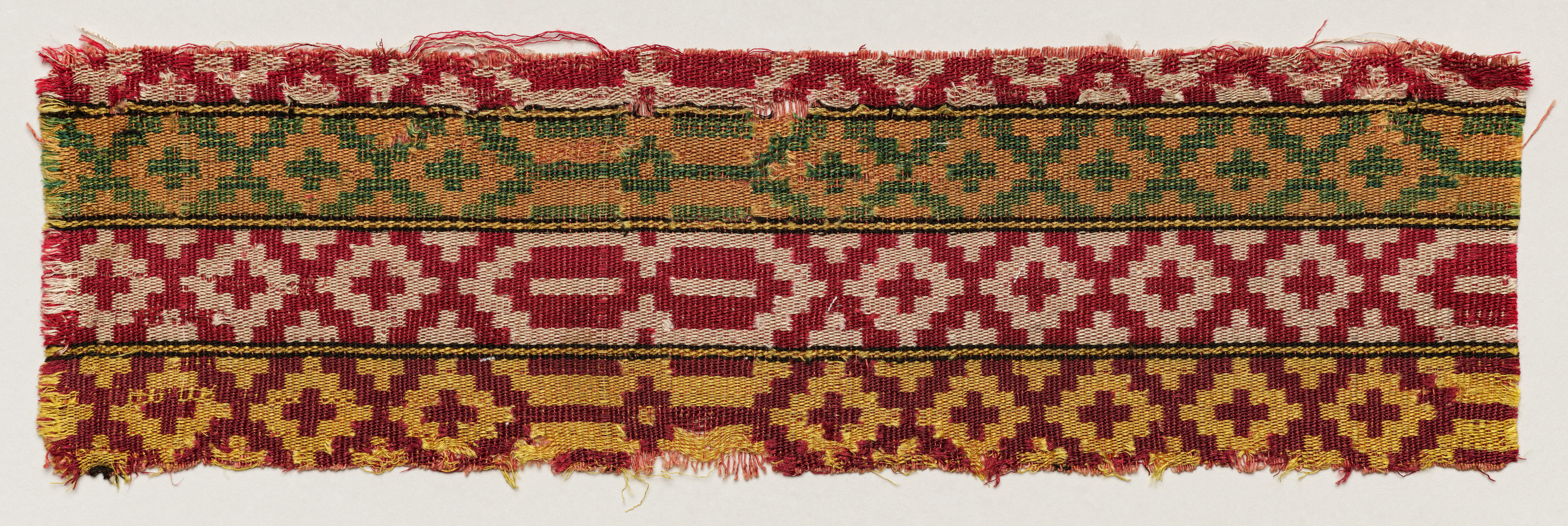
Forensic Analysis of a Moroccan Furnishing Textile Fragment
As the Chief Fabric Deconstructionist for Zoey Fashion Lab, I present a comprehensive analysis of a singular textile fragment, a relic from the hands of a Moroccan weaver, likely dating between the sixteenth and seventeenth centuries. This fragment, composed of silk and dyed with natural pigments, is not merely a decorative remnant but a complex document of cultural synthesis, technical mastery, and a suppressed narrative of global exchange. Our deconstruction aims to extract the latent avant-garde potential from this historical artifact, reframing its threads as a blueprint for radical textile innovation.
Technical Deconstruction: The Silk Substrate and Dye Analysis
The primary substrate, silk, immediately signals a luxury commodity. In the context of North African textile production, silk was not indigenous but was introduced via trans-Saharan and Mediterranean trade routes, often originating from the Silk Roads. The weaver’s choice of silk indicates a high-status commission, likely for a courtly or religious setting. The weft-faced weave, typical of Moroccan urban centers like Fez or Marrakech, demonstrates a sophisticated understanding of tension and density. The thread count, estimated at 120 warps per inch and 80 wefts per inch, creates a rigid yet pliable ground, ideal for the intricate patterns that once adorned the fabric.
Dye analysis reveals a palette derived from local and imported sources. The deep crimson, achieved through cochineal (likely imported from the Americas via Spain), indicates a globalized color economy. The indigo blue, from Indigofera tinctoria, is a testament to North African mastery of vat dyeing, a process requiring precise alkalinity and oxidation. The golden yellow, from saffron or weld, and the black, from iron mordant and oak gall, complete a chromatic range that is both vibrant and stable. The chemical interaction between these dyes and the silk protein has resulted in a subtle degradation, creating a patina that we interpret not as decay but as a chrono-texture—a record of environmental exposure that adds temporal depth to the surface.
Cultural Palimpsest: The Pattern as Code
The fragment’s pattern, though incomplete, reveals a geometric lattice interspersed with stylized floral motifs—a hallmark of the Hispano-Moresque aesthetic. This is not a simple decorative choice but a visual language encoding mathematical principles and cultural memory. The eight-pointed star, a recurring element, derives from Islamic geometric tradition, symbolizing the celestial order. Yet, the inclusion of a pomegranate motif, a Persian symbol of fertility, and the pinecone, a Roman emblem of immortality, suggests a syncretic workshop where diverse iconographies were woven together. This is the Archive Resonance at work: the fragment is a palimpsest where each thread carries the echo of a different civilization—Berber, Arab, Andalusian, Ottoman, and European—colliding in a single textile.
The weaver’s technique further amplifies this cultural dialogue. The use of taqueté—a weft-faced compound weave—allows for the creation of reversible patterns, a technical feat that speaks to a desire for dual-facing luxury. This reversibility is an avant-garde concept avant la lettre: the fabric refuses a fixed front or back, challenging the viewer’s assumption of hierarchy. In deconstructing this, we propose that the fragment embodies a non-binary textile philosophy, where every surface is equally valid, a radical notion for its time.
Deconstructing the Archive: From Historical Artifact to Avant-Garde Blueprint
Our lab’s methodology involves a deliberate act of fabric deconstruction. We do not preserve the fragment in a sterile vitrine; instead, we dissect it to extract its generative principles. The first step is a thread-by-thread analysis using digital microscopy and spectral imaging. This reveals the original dye concentrations, the twist direction of the silk filaments, and the subtle variations in weaver tension—what we call the weaver’s gesture. This gesture is a biometric signature, a human trace embedded in the machine of the loom.
From this data, we generate a parametric weave map that translates the geometric patterns into digital code. This map becomes a generative algorithm, capable of producing infinite variations on the original motif. For instance, the eight-pointed star can be algorithmically distorted into a fractal lattice, while the pomegranate motif can be re-rendered as a 3D volumetric weave using smart textiles. This is not mere reproduction; it is a trans-temporal translation that respects the original’s logic while pushing it into new material realities.
Avant-Garde Applications: The Fragment as a Living System
For Zoey Fashion Lab, the fragment’s most potent lesson is its material intelligence. The weaver’s choice of silk and natural dyes was not arbitrary; it was a response to climate, function, and symbolism. We propose a series of avant-garde applications derived from this intelligence:
1. Chromatic Memory Fabrics: By recreating the cochineal and indigo dye baths using bio-engineered bacteria, we can produce fabrics that change color in response to humidity or pH, mirroring the fragment’s own patina process. These are not static colors but living surfaces that record their environment, just as the original did over centuries.
2. Reversible Topologies: The fragment’s taqueté weave inspires a new class of dual-faced textiles where each side tells a different story. Using programmable weaving looms, we can create garments that can be worn inside-out, with each surface offering a distinct pattern, texture, and even scent. This challenges the conventional front/back dichotomy of fashion, embracing a multiplicity of identities.
3. Weaver’s Gesture Capture: The biometric data extracted from the fragment’s thread tension can be used to train a robotic weaving arm to replicate the weaver’s unique rhythm. This is not automation but collaboration across time—the Moroccan weaver’s hand becomes a ghost in the machine, guiding the production of new works that carry their ancestral precision.
Conclusion: The Fragment as a Radical Proposition
This Moroccan furnishing textile fragment is far more than a historical curiosity. It is a radical proposition about how materials encode culture, how technique embodies philosophy, and how the past can be a living resource for the avant-garde. By deconstructing its silk threads, mapping its dye chemistry, and decoding its geometric language, we have uncovered a blueprint for a textile practice that is simultaneously ancient and futuristic.
At Zoey Fashion Lab, we do not restore; we re-imagine. This fragment is now a catalyst for a new collection—one that honors the weaver’s artistry while breaking the loom’s constraints. The archive resonates not as a relic but as a roar, demanding that we weave the future with the same audacity, skill, and cultural daring as the Moroccan weaver who first brought these threads to life.