Introduction: A Fragment of Opulence in the Avant-Garde Lens
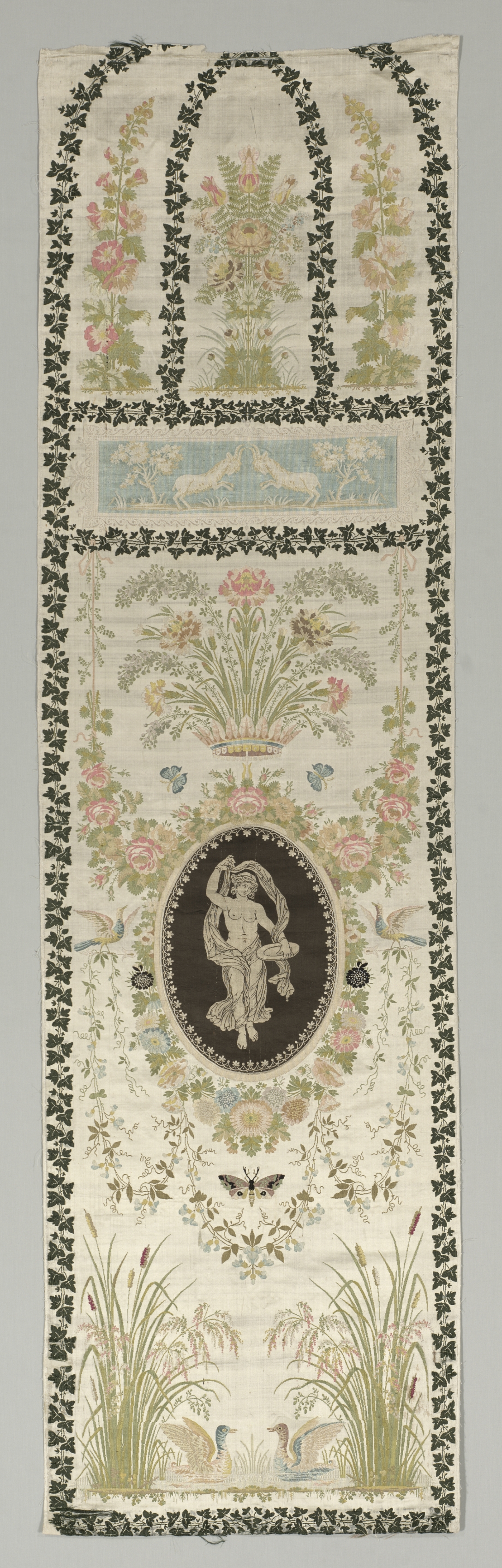
At Zoey Fashion Lab, our mission is to deconstruct historical textile artifacts and reinterpret their material narratives through the prism of avant-garde fashion. The subject of this analysis is a remarkable wall covering fragment from France, dated to the late 18th to early 19th century. This piece is not merely a decorative object; it is a complex document of technical mastery, cultural exchange, and aesthetic ambition. Constructed from silk in a lampas weave—combining a satin ground with a plain weave variant—it is further enriched with brocading, appliqué, and embroidery. The central motif is a classical figure, rendered with the idealized proportions and drapery of Greco-Roman antiquity. For the avant-garde designer, this fragment offers a rich lexicon of textures, structures, and historical references that can be subverted, layered, and recontextualized into radical new forms.
Technical Deconstruction: The Architecture of Silk and Stitch
The Lampas Foundation: A Study in Structural Contrast
The primary weave structure is lampas, a compound weave that allows for a pattern to be created by a secondary warp and weft system. In this piece, the ground weave employs a lustrous satin, providing a smooth, reflective surface that catches light with a liquid sheen. The pattern, however, is executed in a plain weave variant, creating a matte, textured contrast. This interplay of gloss and matte, of smooth and grainy, is a fundamental design principle that the avant-garde fashion designer can exploit. Imagine a garment where the body of a coat is woven in satin-lampas, while the collar and cuffs are cut from the plain weave pattern, creating a dialogue of light absorption and reflection.
Brocading: Metallic Threads and Dimensional Opulence
Brocading involves the addition of supplementary weft threads—often gold, silver, or silk—that are woven only where the pattern requires them. In this fragment, the brocaded elements likely highlight the classical figure’s drapery, laurel wreath, or architectural framing. The metallic threads would have originally shimmered against the silk ground, creating a sense of three-dimensional relief. For the avant-garde, this technique offers a lesson in selective embellishment. Rather than covering a surface uniformly, brocading suggests a strategic placement of ornamentation. A deconstructed evening gown might feature brocaded panels that trace the body’s contours, with loose threads left trailing to expose the construction process itself.
Appliqué and Embroidery: Layering as Narrative
The addition of appliqué—where cut-out pieces of fabric are stitched onto the ground—and embroidery—where threads are stitched into the surface—introduces an even greater level of material complexity. Appliqué might have been used to attach separate silk or velvet shapes, such as a figure’s face or a decorative urn, while embroidery would have added fine details like facial features, floral motifs, or geometric borders. This layering of materials creates a tactile topography. In an avant-garde context, this can be translated into a garment where appliquéd leather or neoprene forms are stitched onto a silk base, with embroidery acting as a kind of structural drawing, holding the disparate elements together while also telling a story of assembly and deconstruction.
Iconographic Resonance: The Classical Figure in a Revolutionary Age
The Idealized Body as Political and Aesthetic Statement
The classical figure—often a goddess, muse, or allegorical representation—was a dominant motif in late 18th and early 19th-century French decorative arts. This period spans the Ancien Régime, the French Revolution, and the rise of the Empire style. The use of classical imagery was not merely decorative; it was a deliberate reference to the ideals of the Roman Republic and Greek democracy. For the avant-garde, this figure becomes a symbol of both timeless beauty and historical rupture. A designer might isolate the figure’s silhouette, abstract it into a geometric pattern, or distort its proportions through digital printing or laser cutting. The classical figure is no longer a passive ornament but an active participant in a dialogue about power, identity, and the body.
Drapery and the Art of Negative Space
The rendering of drapery in this fragment is crucial. The folds of the classical figure’s garment are not merely decorative; they create a rhythm of positive and negative space. The satin ground catches light in the areas of high relief, while the plain weave pattern recedes into shadow. This manipulation of light and shadow is a core principle of avant-garde fashion design. Consider a dress that uses the same principle: a silk satin base with panels of matte silk organza that mimic the folds of classical drapery, but cut asymmetrically to create a sense of movement and tension. The negative space—where the fabric is absent or sheer—becomes as important as the fabric itself.
Archive Resonance: Cultural Collision and the Birth of a New Aesthetic
As noted in the Archive Resonance reference, the 16th and 17th centuries were a period of intense cultural collision and aesthetic fusion. While this fragment dates slightly later, it inherits that legacy. The technique of lampas weaving, for example, has roots in Byzantine and Islamic textile traditions, which were absorbed and transformed by European weavers. The classical figure itself is a revival of ancient Greco-Roman art, rediscovered through Renaissance humanism and the Grand Tour. This fragment, therefore, is not a pure expression of French identity but a hybrid object, bearing traces of Mediterranean, Near Eastern, and European influences.
For the avant-garde designer, this hybridity is a powerful tool. It validates the practice of borrowing, reinterpreting, and synthesizing elements from different cultures and time periods. A collection inspired by this fragment might combine the structural rigor of French lampas with the fluid drapery of Indian saris, or the metallic brocading of Ottoman court textiles. The classical figure could be reimagined through the lens of contemporary identity, perhaps as a non-binary or cyborg figure, stitched together from digital and analog materials. The fragment teaches us that beauty is never static; it is always the result of collision and recombination.
Avant-Garde Recontextualization: From Wall to Body
Deconstruction and Reconstruction
The transition from wall covering to fashion requires a radical act of deconstruction. The fragment is flat, intended to be hung and viewed from a distance. The avant-garde designer must consider how its textures, patterns, and motifs can be translated into three-dimensional, mobile forms. This might involve cutting the silk into strips and reweaving it into a new textile, or using the brocaded threads as structural elements in a garment’s silhouette. The appliqué and embroidery can be detached and reapplied as surface decoration on a sheer base, creating a sense of floating fragments. The classical figure itself can be broken down into its constituent parts—a hand, a fold of drapery, a leaf—and reassembled in a non-linear, abstract composition.
Material Alchemy: Silk Meets Technology
The avant-garde is not limited to historical techniques. The silk lampas can be combined with modern materials like silicone, fiber optics, or recycled plastics. The brocaded metallic threads might be replaced with conductive threads that light up when touched, or with biodegradable glitter that catches light in unexpected ways. The embroidery could be executed by a robotic arm, creating a dialogue between human craft and machine precision. The classical figure could be printed using a 3D printer and then hand-stitched onto the fabric, blurring the line between the ancient and the futuristic. This alchemy of old and new is the essence of the avant-garde spirit.
Conclusion: A Living Archive for Radical Creation
This French wall covering fragment is far more than a historical curiosity. It is a technical manual, an iconographic treasure, and a testament to the enduring power of cultural fusion. For Zoey Fashion Lab, it serves as a living archive—a source of inspiration that challenges us to think beyond the boundaries of time, material, and form. By deconstructing its weave, its motifs, and its history, we uncover the principles of contrast, layering, and narrative that are essential to avant-garde design. The classical figure, once a symbol of static perfection, is now a dynamic element in a radical new vocabulary. In our hands, silk becomes a statement, brocading becomes a code, and embroidery becomes a story waiting to be rewritten.