Deconstructing Heritage: The Porcelain Dialectic in SS26 Avant-Garde Couture
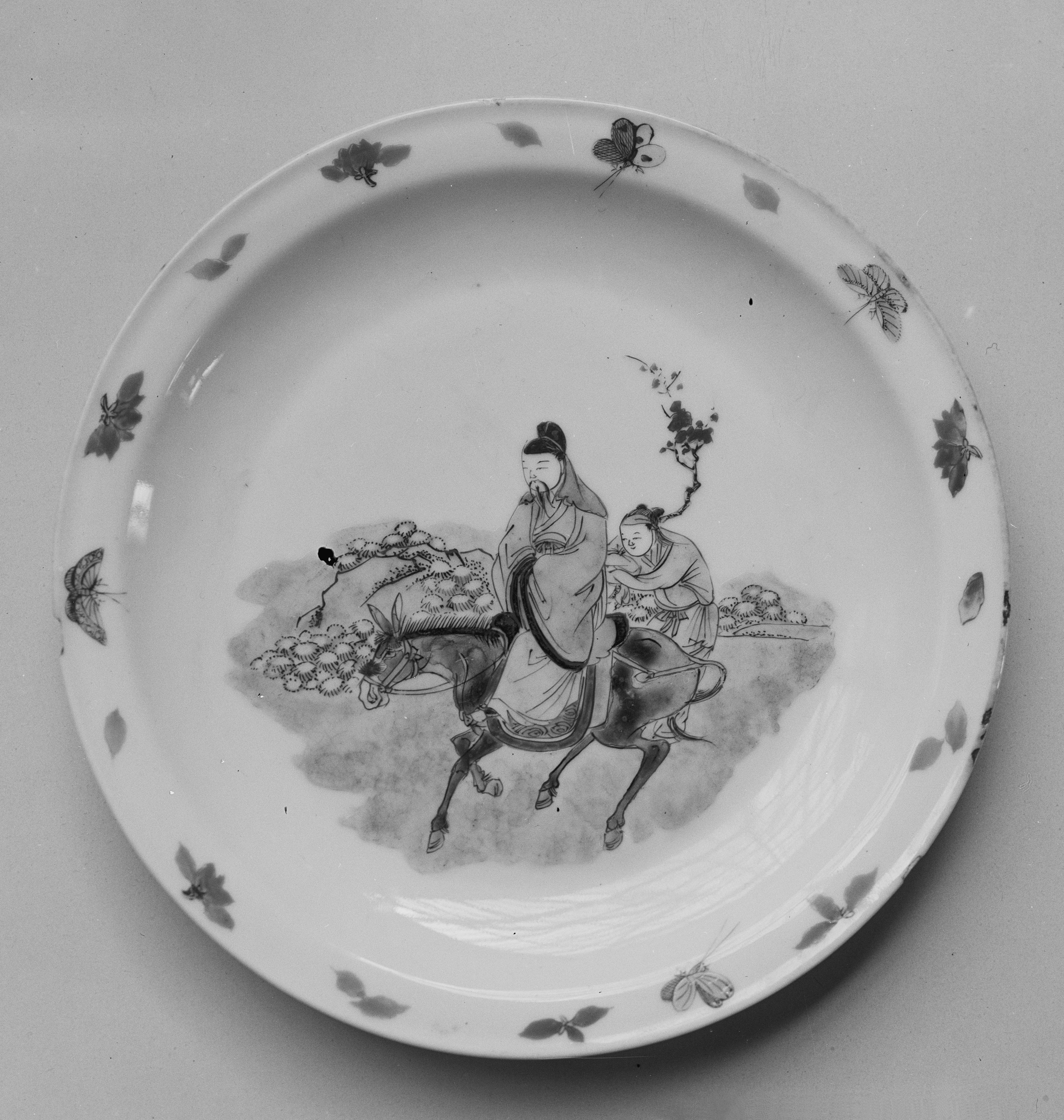
In the crucible of Zoey Fashion Laboratory’s SS26 collection, the Plate with scholar and plum branches—a Jingdezhen porcelain artifact painted with overglaze enamels and gold—emerges not as a relic of the past, but as a radical blueprint for futuristic garment architecture. This piece, with its intricate narrative of a scholar contemplating plum blossoms, becomes a catalyst for a deconstructive aesthetic that interrogates the boundaries between fragility and strength, tradition and technology. The porcelain’s translucent luminosity and gold-veined details inform a new lexicon of structural innovation, where silhouettes are fragmented, layered, and reassembled into wearable sculptures that defy conventional form. The scholar’s quiet contemplation is reimagined as a dynamic tension between stillness and motion, while the plum branches—symbols of resilience—are translated into tensile, branching seams that articulate the body’s kinetic potential.
Fragmenting the Narrative: From Porcelain Surface to Silhouette Architecture
The plate’s surface, a pristine canvas of white porcelain with delicate enamel brushstrokes, serves as the starting point for a futuristic silhouette study. The scholar’s robe, rendered in fluid lines, is abstracted into a series of asymmetrical panels that cascade over the body, mimicking the irregular edges of a broken porcelain shard. These panels are constructed from a custom-developed ceramic-infused organza, a material that captures the translucency of Jingdezhen ware while offering structural rigidity through laser-cut perforations. The plum branches, painted in gold, are transformed into metallic latticework that wraps around the torso, creating a second skin that both reveals and conceals. This lattice is not merely decorative; it functions as a kinetic exoskeleton, with hinges at the shoulders and hips that allow the wearer to modulate their silhouette—expanding or contracting the form like a blooming flower.
The gold enamels, originally applied in thin, precise lines, are reimagined as conductive threads woven into the fabric. These threads, when activated by body heat, emit a soft, ambient glow, referencing the plate’s original luster while introducing a biometric dimension to the garment. The scholar’s contemplative pose is echoed in the garment’s draped asymmetry: one shoulder is exposed, revealing a patch of skin that mimics the plate’s unglazed foot rim, while the opposite side features a high, structured collar that traces the contour of the neck like a porcelain rim. This duality—between exposure and containment—is the core of the design’s avant-garde philosophy.
Structural Innovation: The Plum Branch as Tensile Framework
The plum branches, with their gnarled, twisting forms, are the most potent source of structural innovation. In the SS26 collection, these branches are abstracted into a parametric framework that defines the garment’s architecture. Using 3D-printed biopolymer nodes that mimic the branch’s organic knots, the design team creates a series of articulated joints that allow the fabric to stretch and contract. These nodes are connected by gold-plated titanium cables, which trace the path of the original enamel lines, forming a tensile web that holds the garment in a state of perpetual tension. The result is a silhouette that appears to be frozen in the act of blooming—a nod to the plum blossom’s symbolic association with renewal and perseverance.
The scholar’s figure, traditionally a symbol of intellectual introspection, is recontextualized as a cyborgian entity. The garment’s back panel features a holographic projection of the original plate, overlaid with real-time data from the wearer’s biometric sensors. This projection, visible only in low light, creates a dynamic dialogue between the historical artifact and the wearer’s present moment. The plum branches, meanwhile, extend beyond the garment’s hem into a train of layered tulle, each layer printed with a fragment of the plate’s narrative. As the wearer moves, these layers shift, revealing and obscuring the scholar’s story—a metaphor for the fragmentation of memory in an age of digital saturation.
Material Alchemy: Porcelain, Enamel, and the Future of Textiles
The material palette for this piece is a study in contrasts. The primary fabric, a ceramic-coated micro-mesh, mimics the plate’s glazed surface while offering breathability and flexibility. The overglaze enamels are recreated using chromatic liquid crystals that shift color with temperature changes, referencing the original’s vibrant hues while introducing a thermochromic dimension. The gold elements are not merely applied but electroformed onto the fabric in precise, branching patterns, creating a conductive circuit that powers the garment’s interactive features. These features include a pulse-responsive LED system embedded in the plum branch lattice, which flickers in sync with the wearer’s heartbeat—a direct translation of the plate’s static gold lines into a living, breathing interface.
Silhouette as Statement: The Fragmented Scholar
The final silhouette is a deconstructed coat-dress that challenges traditional notions of tailoring. The left side is a structured, corseted bodice with a high, porcelain-like collar, while the right side dissolves into a series of floating panels that suggest the scholar’s robes in motion. The plum branch lattice emerges from the waist, spiraling upward to form a single, exaggerated sleeve that extends beyond the hand—a nod to the scholar’s brushstroke. The hem is asymmetrical, with a laser-cut pattern that replicates the plate’s cracked glaze, revealing a second layer of iridescent silk beneath. This layering creates a visual depth that mirrors the plate’s three-dimensional enamel work.
In the context of SS26, this piece is not merely a garment but a philosophical statement. It argues that heritage is not a static artifact to be preserved but a dynamic framework for innovation. The scholar’s introspection becomes a metaphor for the avant-garde designer’s process: a constant dialogue between past and future, form and function, fragility and resilience. The plum branches, once decorative, become the structural spine of a new fashion paradigm—one where every line, every curve, every fragment is imbued with meaning. This is the essence of Zoey Fashion Laboratory’s vision: to deconstruct the past and reconstruct it as a futuristic, wearable architecture that challenges the wearer to see themselves as both artifact and architect of their own identity.