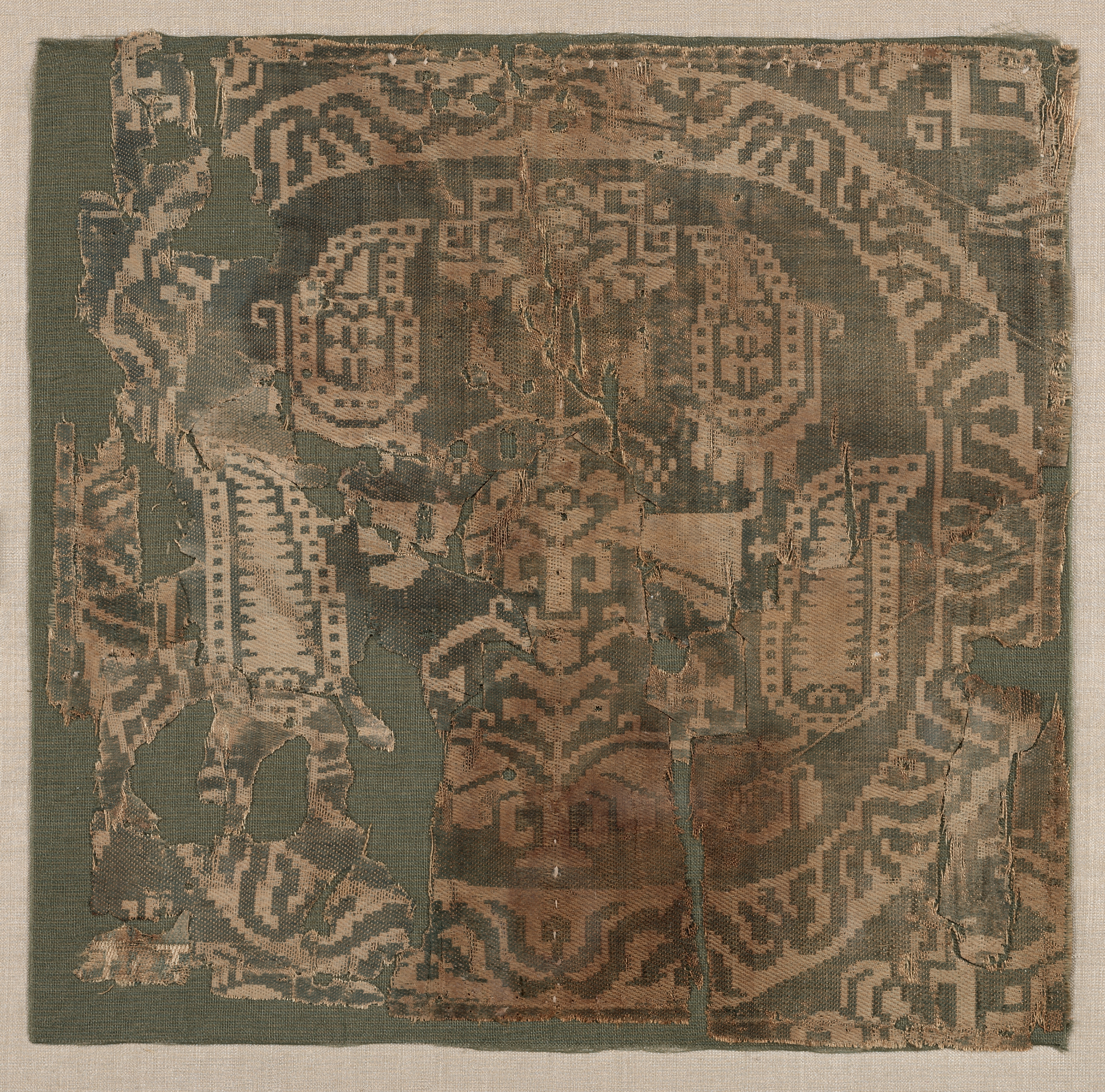
Deconstructing the Avant-Garde: A Technical and Aesthetic Analysis of the Roundel from a Tunic with Palmette Tree
Introduction: The Artifact as a Catalyst for Design Innovation
At Zoey Fashion Lab, our mission is to interrogate historical textiles not as static relics, but as living blueprints for avant-garde expression. The Roundel from a Tunic with Palmette Tree, attributed to 10th–12th century Egypt or Syria, presents a compelling case study. Its technical sophistication—executed in silk using a complementary weft-faced twill weave with inner warps (samite)—offers a rich vocabulary for deconstruction. This analysis will dissect its structural DNA, symbolic resonance, and materiality, proposing how such an artifact can inform a new, disruptive aesthetic within the Zoey Fashion Lab framework. The roundel is not merely an ornament; it is a New DNA Strand for fashion’s future.
Technical Deconstruction: The Samite Architecture
The roundel’s weave is a masterpiece of pre-industrial engineering. Samite, a compound weave structure, achieves its luminous effect through a complementary weft-faced twill where multiple weft systems interlace with a single warp system, while inner warps—often of a different material or tension—create a stable, floating ground. In this piece, the silk warp and weft produce a fabric that is both supple and weighty, with a surface that shifts in light like liquid metal. For the avant-garde designer, this structural complexity is a direct challenge to contemporary flatness.
We propose a deconstructive protocol: reverse-engineering the samite’s tension. By isolating the inner warps and releasing them from the weft-faced structure, we can create a three-dimensional, lattice-like textile that retains the original’s sheen but introduces transparency and volume. This process, which we term “weft liberation,” transforms the roundel’s dense, iconic motif into a fragmented, architectural silhouette. The palmette tree—a stylized, symmetrical form—becomes a series of floating, dislocated branches, echoing the deconstructionist ethos of breaking down form to rebuild it.
Symbolic Recontextualization: The Palmette Tree as a Non-Linear Narrative
The palmette tree is a ubiquitous motif in Islamic art, symbolizing paradise, fertility, and the cosmic axis. Its repetition within the roundel suggests a cyclical, ordered universe. However, the avant-garde mind rejects linearity. At Zoey Fashion Lab, we reinterpret this motif as a non-linear narrative—a visual code that can be scrambled, mirrored, and inverted. The roundel’s circular format, traditionally a closed system, is instead a portal to multiplicity.
We advocate for a deconstruction of the motif’s symmetry. By digitally scanning the roundel and applying algorithmic distortion—stretching, rotating, and fragmenting the palmette tree—we generate a generative pattern that can be printed onto silk organza or laser-cut into leather. This process respects the original’s symbolic weight while subverting its static nature. The resulting garment, perhaps an asymmetric tunic or a deconstructed cape, becomes a wearable palimpsest—a surface where the past is visible but not fixed, inviting the wearer to engage with history as a mutable, personal narrative.
Materiality and the Avant-Garde: Silk as a Medium of Disruption
Silk, in its historical context, was a marker of wealth, status, and ritual. The roundel’s silk, dyed with natural pigments, possesses a chromatic depth that synthetic fibers cannot replicate. For the avant-garde, this materiality is a tool for tactile provocation. We propose a contrast between the original’s polished finish and raw, unfinished edges. By leaving the weft threads exposed at the garment’s seams or by incorporating raw silk slubs into the weave, we create a tension between luxury and decay, refinement and rawness.
This approach aligns with the deconstructionist aesthetic pioneered by designers like Rei Kawakubo and Martin Margiela, who celebrated the unfinished, the frayed, and the inverted. The roundel’s complementary weft-faced structure is particularly suited to such treatment. By cutting into the weft and allowing the inner warps to surface, we can produce a garment that appears to be in a state of becoming—a textile that is simultaneously whole and fragmented. This is not a reproduction; it is a rebellion against the original’s perfection.
Avant-Garde Applications: From Roundel to Wearable Sculpture
How does this analysis translate into a tangible collection? We envision a series of pieces that reference the roundel’s circular geometry but reject its symmetry. A deconstructed tunic might feature a single, oversized roundel appliqué that is partially detached, revealing a grid of inner warps beneath. The palmette tree could be embroidered in metallic thread on a sheer silk base, its branches extending beyond the garment’s hem, suggesting growth and dissolution.
Alternatively, the roundel’s samite weave can be reconstructed as a modular system. Individual roundels, each a fragment of the original pattern, could be connected with visible stitching or metal grommets, allowing the wearer to rearrange them. This interactive garment challenges the notion of a fixed design, embodying the avant-garde principle of perpetual change. The New DNA Strand reference is literal here: the roundel becomes a genetic code that can be spliced, mutated, and recombined.
Conclusion: The Roundel as a Blueprint for the Future
The Roundel from a Tunic with Palmette Tree is not a historical artifact to be preserved in a vitrine; it is a provocation to create. Its technical complexity, symbolic richness, and material opulence offer a foundation for avant-garde experimentation. At Zoey Fashion Lab, we see it as a New DNA Strand—a genetic template that, when deconstructed and reassembled, yields garments that are both deeply rooted and radically new. By embracing weft liberation, non-linear symbolism, and tactile disruption, we transform a 12th-century roundel into a 21st-century statement. This is not nostalgia; it is deconstruction as creation. The palmette tree no longer stands still; it grows, fractures, and evolves, just as fashion must.