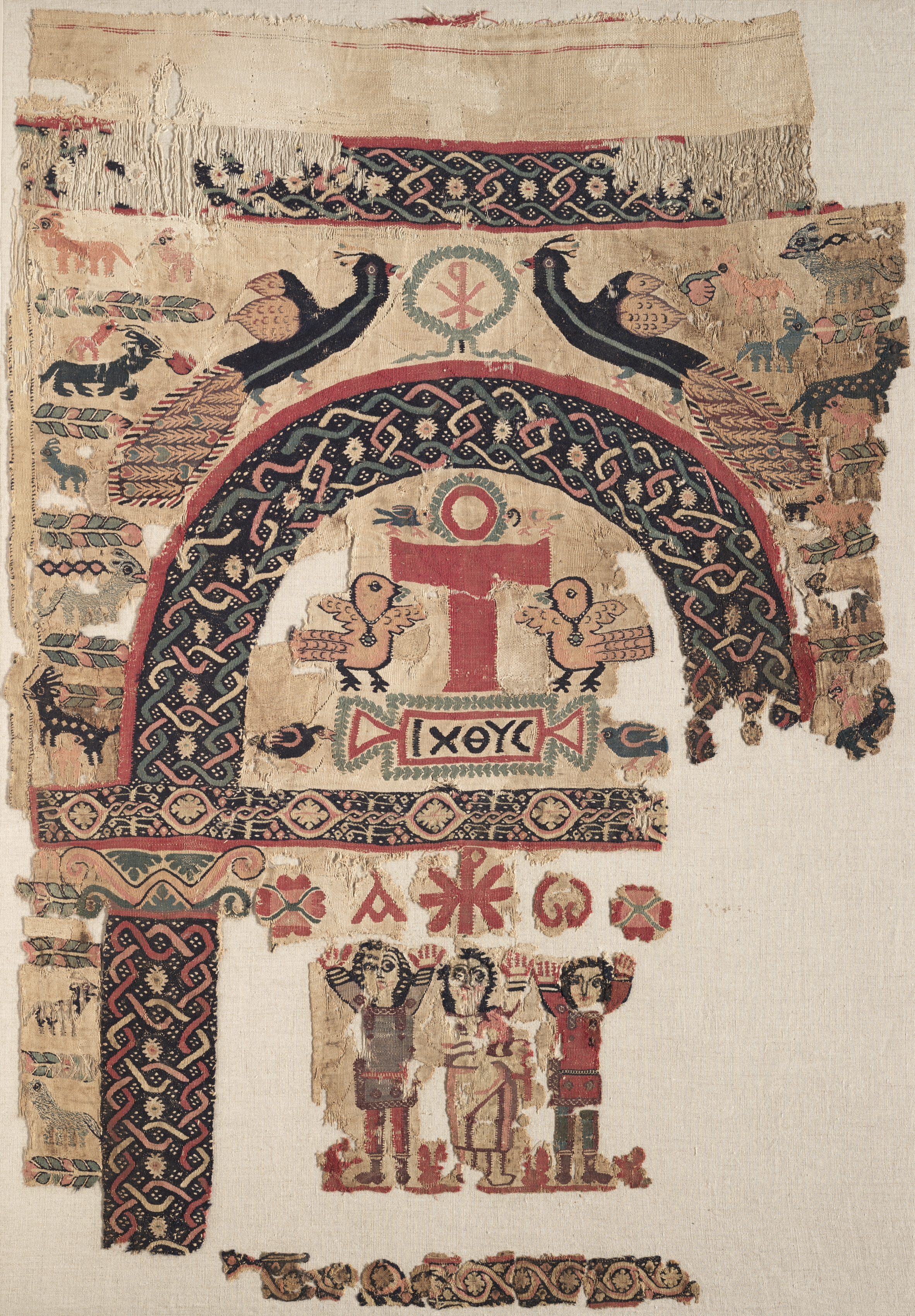
Fabric Deconstruction Report: Hanging with Christian Images
Archaeological Context and Provenance
This textile, originating from Egypt during the Byzantine period (circa 4th–7th century CE), represents a pivotal moment in the intersection of religious iconography and material culture. The Hanging with Christian Images is a rare surviving example of Coptic textile art, where indigenous Egyptian weaving traditions merged with the iconographic demands of early Christianity. The piece’s provenance from the Nile Valley—a region known for its arid preservation conditions—has allowed for the remarkable survival of its dyed wool and undyed linen components. As a plain weave (tabby) with inwoven tapestry weave, this hanging exemplifies the technical sophistication of Byzantine-era workshops that served both liturgical and domestic functions. The Christian imagery, likely depicting scenes such as the Virgin Mary, Christ, or saints, was not merely decorative but served as a visual theology for a community navigating the transition from pagan to Christian dominance.
Technical Analysis: Material and Construction
The fabric’s construction reveals a deliberate hierarchy of materials. The undyed linen warp provides structural integrity, while the dyed wool weft introduces chromatic depth through natural dyes derived from madder (red), woad (blue), and weld (yellow). The tabby weave, the simplest form of interlacing, creates a stable ground for the more complex tapestry weave—a technique where colored wefts are woven discontinuously to form figurative or geometric patterns. This combination allowed the weaver to achieve both durability for hanging and pictorial clarity for religious narratives. The tapestry elements are inwoven, meaning they are integrated into the ground weave rather than applied as an afterthought, demonstrating a mastery of tension control and thread manipulation. Notably, the wool’s slight shrinkage over centuries has created a subtle distortion in the linen, producing a tactile dissonance that the avant-garde eye might interpret as organic imperfection—a quality that contemporary designers often seek to emulate in deconstructed fashion.
Iconographic and Symbolic Resonance
The Christian imagery on this hanging is not static but performative in its function. The figures, likely rendered with stylized frontal faces and elongated proportions typical of Byzantine art, were designed to be viewed in a liturgical context—perhaps as a curtain for an altar or a wall hanging in a domestic oratory. The iconography serves as a visual anchor for prayer, mediating between the material and the divine. For the avant-garde fashion lab, this offers a profound lesson: clothing and textiles are not merely coverings but carriers of narrative. The hanging’s imagery, when deconstructed, can be reinterpreted as a series of graphic motifs—abstracted halos, geometric drapery, or symbolic animals (such as the peacock or fish)—that can be translated into prints, embroidery, or appliqué. The tension between the sacred and the everyday in this piece challenges modern designers to imbue their work with layers of meaning that transcend mere aesthetics.
Avant-Garde Interpretation: Deconstruction as Liberation
From an avant-garde perspective, the Hanging with Christian Images is not a relic but a template for rebellion. The plain weave’s monotony is broken by the tapestry’s interruption, mirroring the avant-garde principle of disruption. The undyed linen—raw, unadorned—serves as a ground for the dyed wool’s chromatic outburst, much like a blank canvas awaiting a mark. In deconstructing this piece for Zoey Fashion Lab, we propose a radical recontextualization: extract the tapestry motifs and isolate them as standalone elements—a halo becomes a collar, a saint’s hand becomes a cuff, a geometric border becomes a hemline. The warp and weft themselves can be exaggerated, with loose threads left to dangle as a commentary on the fragility of belief systems. This approach aligns with the Archive Resonance reference, which speaks to the “silent witness” of cultural collision. The Byzantine period was itself an era of cultural fusion—Egyptian, Greek, Roman, and Christian influences coalescing. The avant-garde designer can channel this hybridity by juxtaposing the hanging’s sacred imagery with profane materials (e.g., latex, metal mesh) or by distorting its proportions through digital manipulation.
Color Palette and Texture as Narrative Tools
The surviving color palette—faded madder red, indigo blue, and ochre yellow—evokes a monastic restraint that the avant-garde can subvert. Imagine a garment where the red is not a solid block but a bleeding gradient, suggesting the passage of time and the erosion of faith. The undyed linen, with its natural beige hue, becomes a neutral ground for experimentation: it can be overdyed, burned, or chemically distressed to mimic the hanging’s age. The texture of the tapestry weave—raised, tactile—can be replicated through jacquard knitting or 3D printing, creating a surface that invites touch and contemplation. The avant-garde designer might also invert the hanging’s technical structure: use wool for the base and linen for the decorative elements, or weave the tapestry with synthetic fibers that glow under UV light, transforming the sacred into the psychedelic.
Deconstruction Protocol for Zoey Fashion Lab
We propose a three-phase deconstruction of this artifact. First, analytical dissection: map the hanging’s weave structure, identifying the points of tension where the tapestry interrupts the tabby. Second, motif extraction: isolate the Christian symbols—crosses, halos, figures—and abstract them into geometric forms that can be scaled, rotated, or mirrored. Third, material reimagining: replace the wool with recycled polyester and the linen with organic cotton, honoring the original’s natural fibers while addressing contemporary sustainability. The final garment—a deconstructed coat or a fragmented dress—should retain the hanging’s archaeological aura: visible seams, raw edges, and intentional asymmetry. This is not a costume but a wearable archive, a dialogue between the Byzantine weaver and the avant-garde designer. The silent witness of the original piece now speaks through the language of fashion, echoing the “cultural collision” referenced in the Archive Resonance. The result is a garment that is both a deconstruction of history and a construction of future identity.