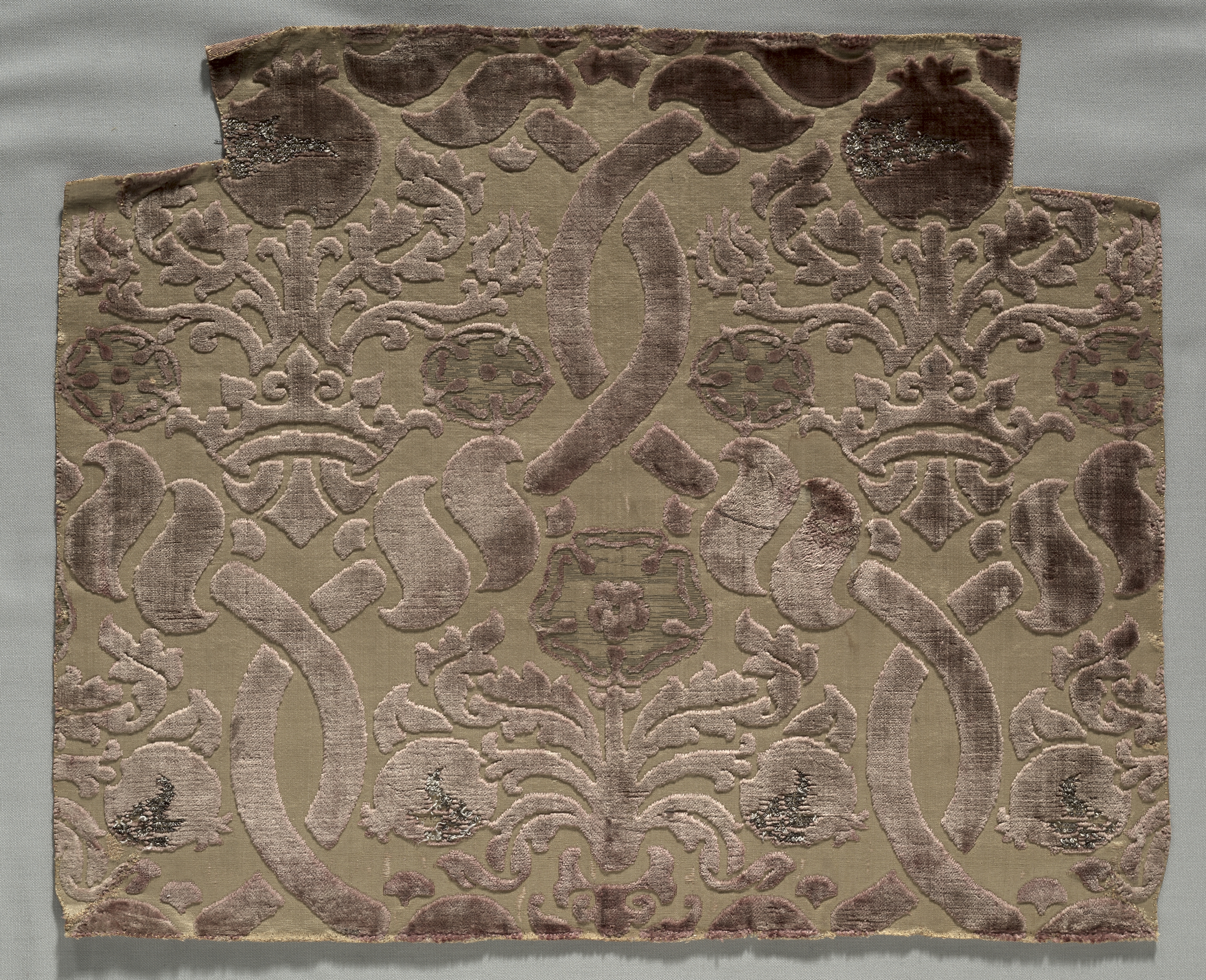
Deconstructing the Renaissance: A Technical Analysis of the 16th Century Italian Velvet Fragment
As the Chief Fabric Deconstructionist for Zoey Fashion Lab, I am tasked not merely with cataloging historical textiles, but with dissecting their DNA to extract the genetic code for future innovation. The subject of this analysis—a fragment of Italian velvet from the 16th century—is a masterclass in opulence and technical prowess. Yet, for our Avant-garde division, it represents something far more potent: a New DNA Strand. This fragment is not a relic to be preserved under glass; it is a blueprint for rebellion. By deconstructing its weave, we can unlock a visual language of texture, depth, and controlled chaos that speaks directly to the future of fashion.
I. The Material Matrix: Silk as a Conductive Medium
The foundation of this fragment is silk, a protein-based fiber that behaves less like a passive material and more like a responsive substrate. In the 16th century, Italian silk was the apex of luxury, prized for its natural luster, dye affinity, and tensile strength. For Zoey Fashion Lab, we view silk not as a historical artifact, but as a conductive medium for light and shadow. The fragment’s silk warp and weft create a surface that is inherently dynamic. When we consider this through an Avant-garde lens, the silk’s natural sheen becomes a tool for optical manipulation. In a modern context, we could engineer this silk to incorporate metallic or even photochromic threads, transforming the velvet’s inherent play of light into an interactive, responsive garment surface. The 16th-century weaver understood that silk was a canvas for depth; we must understand it as a canvas for temporal change.
II. The Weave Architecture: Cut, Uncut, Voided, and Brocaded
The true complexity of this fragment lies in its composite weave structure. It is not a single, uniform velvet, but a layered narrative of pile and ground. Let us deconstruct each element:
Cut Velvet: The most classic form, where loops of the pile warp are sheared to create a dense, soft, and highly reflective surface. In this fragment, the cut areas form the primary motifs—likely floral or arabesque patterns. From a deconstructionist perspective, the cut pile acts as a positive space, a field of high-definition texture that demands visual attention. Its softness is not just tactile; it is a statement of controlled luxury. For an Avant-garde reinterpretation, we might consider laser-cutting or chemically dissolving sections of a modern velvet to create a deliberate, distressed “cut” effect that mimics the historical technique but with a brutalist, industrial edge.
Uncut Velvet (Terry): The loops that remain intact create a matte, granular texture. In the 16th century, this was often used for background or secondary details. For us, the uncut pile is a negative space—a field of potential. It is rougher, less reflective, and acts as a visual “ground” against which the cut pile shines. The contrast between cut and uncut is the fragment’s primary tactile dialectic. In our lab, we would explore how to exaggerate this contrast, perhaps by using different fiber types for each—a smooth, liquid-like cut pile versus a coarse, almost burlap-like uncut pile—to create a jarring, post-modern tension.
Voided Velvet: This is where the pile is completely absent, revealing the ground weave (typically a satin or taffeta base). In the fragment, voided areas create sharp, negative outlines around the motifs. This is a technique of erasure. The void is not empty; it is a deliberate silence in a loud textile. For our Avant-garde work, voided velvet is a direct precursor to deconstructivist fashion—think of Rei Kawakubo’s deliberate holes and gaps. We can push this further by voiding not just the pile, but the ground itself, creating literal transparency or lattice-like structures that expose the body or an underlayer.
Brocaded Velvet: The fragment incorporates supplementary weft threads (often metallic gold or silver) to add intricate, raised patterns. This is the ornamental climax of the textile. Brocading introduces a third dimension of color and reflectivity. In the 16th century, this was reserved for the most prestigious commissions. For Zoey Fashion Lab, brocading is a lesson in strategic excess. We would not replicate the gold thread, but rather reinterpret the concept of “supplementary” ornamentation using modern materials—perhaps conductive threads that light up, or thermochromic pigments that change color with body heat. The brocade becomes not a static decoration, but a dynamic, interactive element.
III. The New DNA Strand: From Historical Syntax to Avant-Garde Grammar
This fragment’s true value for our Avant-garde division is not in its beauty, but in its syntactical structure. It is a textile that speaks in four distinct voices: cut (assertion), uncut (murmur), voided (silence), and brocaded (exclamation). This is a grammar of texture that we can deconstruct and reassemble. The “New DNA Strand” we propose is a genetic algorithm for fabric design, where these four states are not fixed but can be algorithmically randomized or user-controlled.
Imagine a garment where the cut pile is digitally printed with a reactive dye that only activates under UV light; the uncut pile is made of a moisture-wicking microfiber; the voided areas are laser-cut into geometric, asymmetrical patterns; and the brocaded sections are replaced with flexible LED filaments. The historical fragment’s rigid, symmetrical motifs (likely pomegranates or acanthus leaves) would be replaced by glitch art, fractal geometry, or organic, biomorphic forms. The result is a velvet that is no longer a symbol of static wealth, but a living, breathing interface between the wearer and their environment.
IV. Technical Implications for Zoey Fashion Lab
To realize this vision, we must move beyond traditional weaving. The 16th-century velvet was woven on a drawloom with a second warp beam for the pile. Our modern equivalent would be a multi-layered, multi-material 3D-knitting or jacquard weaving system that can seamlessly transition between cut, uncut, voided, and brocaded states. We would need to engineer yarns that can be selectively sheared (cut) via thermal or chemical processes post-production, or even by the wearer’s own movement (e.g., friction-based pile release). The voided areas could be created not by weaving, but by selective dissolution of a water-soluble yarn in a specific pattern, leaving behind a lace-like negative space.
The brocaded element, historically metallic, could be replaced by conductive silver-coated nylon that is integrated into the weave. This would allow the fabric to house micro-sensors or small haptic motors, turning the garment into a second skin that responds to touch, temperature, or even biometric data. The velvet’s historical function as a signifier of status is thus subverted; it becomes a signifier of interactive intelligence.
V. Conclusion: The Fragment as a Provocation
This 16th-century Italian velvet fragment is not a dead object. It is a provocation. It challenges us to ask: What is the modern equivalent of a hand-woven silk pile? What does “luxury” mean when texture can be programmed and light can be embedded? By deconstructing its technical DNA—cut, uncut, voided, brocaded—we find not a historical limitation, but a template for radical innovation. For Zoey Fashion Lab, this fragment is the seed of a new textile language: one that honors the craftsmanship of the past while violently, beautifully, and Avant-gardely breaking it apart to build something entirely new. The velvet is no longer a fabric; it is a system. And we are its architects.