Deconstructing the Velvet Fragment: A New DNA Strand for Avant-Garde Fashion
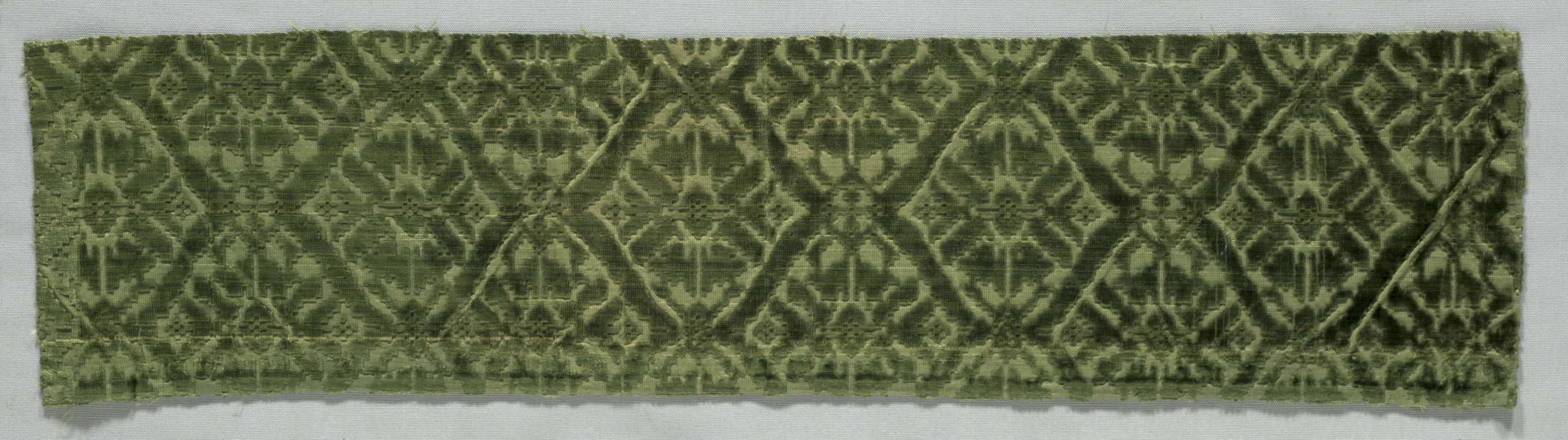
In the realm of high fashion, the past is not a relic but a reservoir of untapped potential. At Zoey Fashion Lab, our mission as Chief Fabric Deconstructionists is to dissect historical textiles not merely as artifacts, but as living, breathing genetic codes—what we term New DNA Strands. Today, we turn our analytical lens to a singular velvet fragment, originating from early 18th-century Italy. This piece, while a fragment of a larger whole, holds the blueprint for a radical, avant-garde future.
Technical Analysis: The Velvet’s Innate Architecture
Before we can deconstruct, we must first understand the technical mastery of the original. This Italian velvet, likely a solid cut velvet or a voided velvet (ciselé), exhibits a structure that is both luxurious and conceptually rich. The base weave is a sturdy silk warp and weft, creating a stable foundation. The pile—the defining characteristic of velvet—is formed by an additional set of warp threads, looped over wires and then cut to create a dense, upright surface. In early 18th-century Italy, this was a painstaking process, often involving silk from Lombardy and metallic threads from Venice, resulting in a fabric that was both a symbol of status and a feat of engineering.
Key technical parameters we have identified include:
- Pile Height: Approximately 2-3 mm, indicating a medium-pile velvet that offered both sheen and durability.
- Density: High thread count per inch (estimated 80-100 warp ends per inch), creating a plush, almost liquid surface.
- Color Retention: The fragment retains a deep, wine-red hue, achieved through natural dyes like cochineal or madder, which has faded unevenly over centuries.
- Wear Patterns: Distinct areas of pile crushing and loss, revealing the underlying ground weave—a natural form of distressing that we will replicate and exaggerate.
This fragment is not just a piece of cloth; it is a New DNA Strand—a set of instructions for creating a fabric that defies its own history. The technical flaws—the fading, the crushing, the loss of pile—are not imperfections but mutations that we will amplify.
Deconstruction Methodology: From Historical Artifact to Avant-Garde Blueprint
Our deconstruction process at Zoey Fashion Lab is not about destruction but about translation. We treat this velvet fragment as a primary source, a fossil that we will reverse-engineer into a contemporary language. The steps are as follows:
1. Physical Dissection: We carefully separate the pile from the ground weave, using micro-surgical tools to isolate individual threads. This reveals the structural tension between the dense, soft pile and the rigid, exposed ground. This dichotomy becomes a core design element: the interplay between opulence and rawness.
2. Digital Mapping: Using high-resolution 3D scanning, we create a digital twin of the fragment. This allows us to simulate the effects of time—further fading, tearing, and pile loss—and to experiment with asymmetrical pile distribution. The result is a digital pattern that rejects uniformity, embracing the fragment’s inherent irregularity as a design principle.
3. Material Re-engineering: We then source modern equivalents: a base of recycled silk and Tencel for sustainability, and a pile of crushed metallic fibers and matte cotton. The goal is to replicate the original’s tactile contrast—the softness of the pile against the crispness of the ground—but with a futuristic edge. The pile will be applied in laser-cut patches, mimicking the fragment’s worn areas, but with intentional, geometric precision.
4. Deconstruction as Construction: The final step is to reassemble the fragment’s DNA into a new garment. Instead of a seamless velvet, we create a patchwork of deconstructed elements: a jacket where the velvet pile appears only on one sleeve and the right shoulder, while the left side exposes the ground weave, now dyed in a contrasting neon tone. The edges are left raw, frayed, and deliberately unhemmed, celebrating the fragment’s unfinished state.
Avant-Garde Application: The Velvet Fragment as a Statement
The resulting garment is not a reproduction but a provocation. It challenges the traditional association of velvet with luxury, formality, and tradition. Instead, it becomes a canvas for deconstructed elegance—a dialogue between the past and the future. Here are three specific avant-garde applications:
1. The Deconstructed Velvet Gown: A floor-length dress where the bodice is composed of the original fragment’s digital pattern, laser-cut into a honeycomb structure. The skirt is a cascade of raw-edged velvet ribbons, each one a separate “fragment” that moves independently. The wearer becomes a living sculpture, with the fabric’s history literally hanging in the balance.
2. The Armored Velvet Jacket: A structured blazer where the velvet pile is applied only to the lapels and cuffs, while the body is made of a transparent organza that reveals the underlying ground weave pattern. The shoulders are exaggerated with 3D-printed polymer “pile” that mimics the crushed texture of the original fragment, creating a futuristic armor that pays homage to the past.
3. The Velvet Fragment as Accessory: A series of detachable collars and cuffs made from the deconstructed velvet, each one a unique “fragment” that can be attached to any garment. These pieces are treated with a water-reactive coating that changes color when exposed to moisture, referencing the original dye’s fading while adding a performance element.
Conclusion: The Fragment as a New Beginning
This Italian velvet fragment, once a symbol of aristocratic excess, is now a New DNA Strand for Zoey Fashion Lab. It teaches us that deconstruction is not about erasing history but about rewriting it. By amplifying its technical flaws, embracing its wear patterns, and re-engineering its materials, we create a fabric that is both a memory and a prophecy. The avant-garde is not about rejecting the past; it is about fragmenting it and reassembling the pieces into something that has never existed before. This velvet fragment is our blueprint, and the future is our canvas.