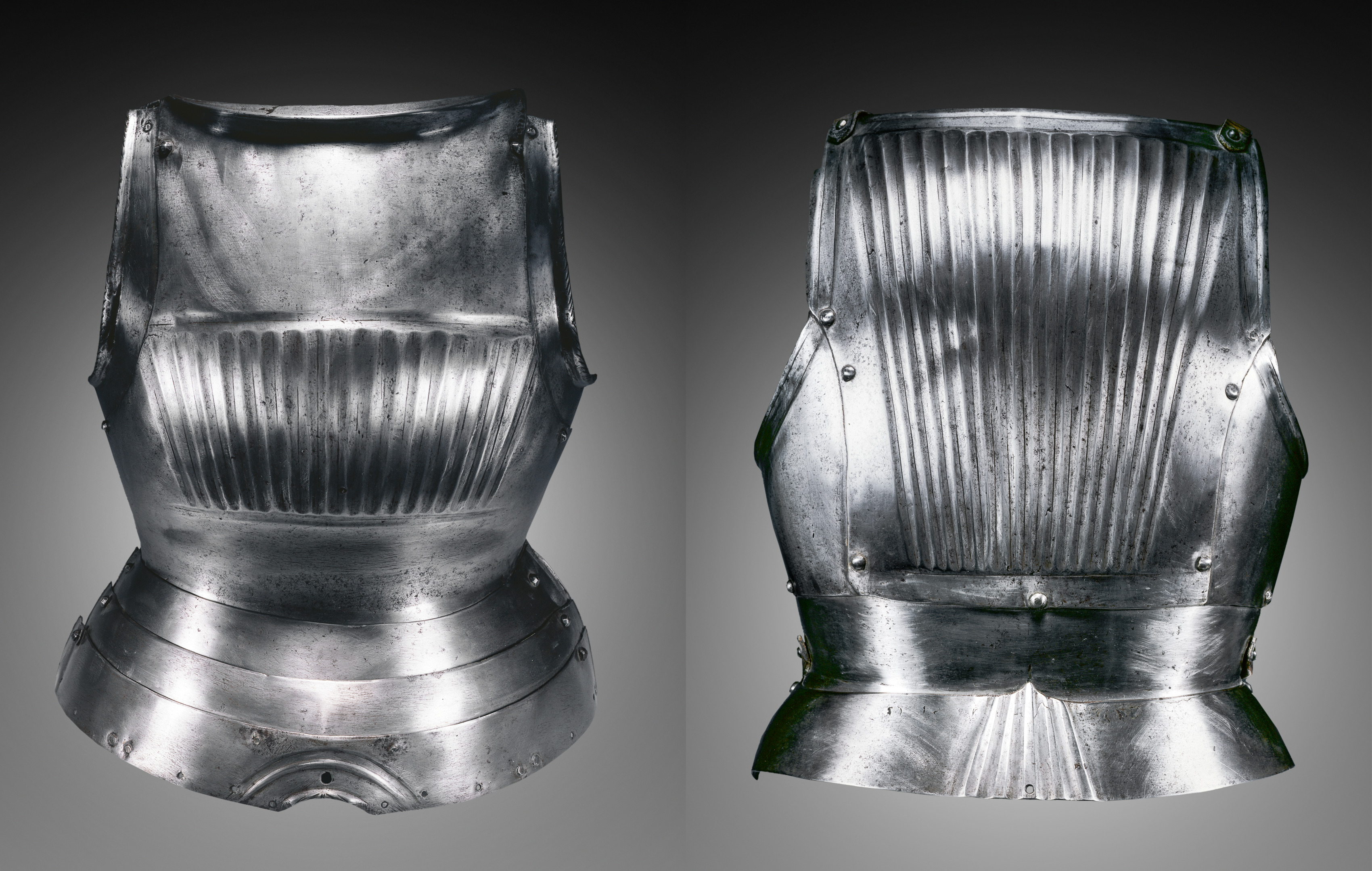
Deconstructing the Steel Silhouette: An Avant-Garde Analysis of a Maximilian Breast and Backplate
At Zoey Fashion Lab, we do not merely study historical garments; we dissect them to extract the genetic code of future fashion. The subject of this analysis is a set of breast and backplates from a Maximilian armor, likely crafted in Nuremberg, Germany, during the early 16th century. Composed of steel with brass rivets, this object is far more than a relic of medieval warfare. It is a structural manifesto, a precursor to modern architectural dressing, and a rich source of inspiration for our avant-garde design philosophy. We will deconstruct this armor not as a protective shell for a knight, but as a New DNA Strand—a foundational blueprint for reimagining the human form, power, and vulnerability in contemporary fashion.
I. The Armor as a Second Skeleton: Structural DNA
The Maximilian armor is renowned for its fluted surfaces and rounded, almost organic forms. This is not a flat, rigid carapace. The breastplate is deeply curved, with a pronounced central ridge that mimics the sternum and pectoral muscles. The backplate mirrors this, creating a negative-positive spatial relationship that defines the torso as a sculptural volume. From an avant-garde perspective, this is a radical act: the armor does not simply cover the body; it redefines its architecture. The steel becomes an exoskeleton, a second, more powerful skeleton worn on the outside.
Our lab sees this as a direct predecessor to the structural corsetry and exaggerated silhouettes of designers like Rei Kawakubo or Thierry Mugler. The fluting—those parallel, rounded grooves—is not decorative. It is a stress-distribution system. In fashion terms, this translates to engineered pleating, ribbed textiles, and 3D-printed panels that create both visual rhythm and physical support. The brass rivets, far from being mere fasteners, are nodes of tension. They mark points where the steel skin is anchored to itself, creating a lattice of strength. For our new collection, we will reinterpret these rivets as metallic grommets, laser-cut seams, and exposed stitching that act as both functional closures and decorative motifs, emphasizing the construction process itself.
II. The Paradox of Protection: Vulnerability and Power
A Maximilian armor is designed to deflect a lance or a sword blow. Yet, paradoxically, it also reveals the body it protects. The breastplate is molded to the male torso, with articulated lames at the waist and shoulders allowing for movement. This is not a denial of the body; it is a celebration of its potential. The armor creates a hyper-idealized silhouette—broad shoulders, a narrow waist, a powerful chest. It is a performance of masculinity as much as a defensive tool.
In our avant-garde analysis, this duality is crucial. The armor represents controlled vulnerability. The wearer is both exposed (the form is visible) and shielded (the material is impenetrable). This tension is a core tenet of our design language. We will translate this through sheer panels over rigid structures, transparent polymers layered over metalized fabrics, and cutouts that reveal the body while a secondary, harder shell protects it. The brass rivets, which on the original armor are cold and hard, become warm, glowing LED points in our reimagining—signals of life and energy within the steel cage.
III. The Fluting as Rhythmic Textile: Surface and Movement
The fluting on a Maximilian breastplate is not random. It follows the contours of the torso, creating a visual flow that guides the eye from the neck to the waist. This is kinetic sculpture. When the wearer moves, the light plays across the grooves, creating a shimmering, liquid effect despite the rigid material. This is a primitive form of optical fabric—a surface that changes appearance with perspective and motion.
Our lab will extract this principle to develop a new textile: “Ribbed Steel Silk.” Using a combination of laser-cut leather, thermoplastic polyurethane (TPU), and micro-pleated organza, we will create a fabric that mimics the fluting’s depth and reflectivity. The grooves will be functional, allowing for ventilation and flexibility, while maintaining the visual density of armor. The brass rivets will be reimagined as sonic studs—small, embedded speakers that emit low-frequency vibrations, turning the garment into an instrument of resonance. The fluting becomes a score, the rivets becomes notes, and the wearer becomes a conductor.
IV. The Backplate: The Unseen Narrative
In traditional armor analysis, the backplate is often overlooked. It is the hidden side, the support system. Yet, in Maximilian designs, the backplate is equally sculpted, with its own fluting and articulation. This is a complete volumetric garment. We see the backplate as a symbol of the unseen labor of fashion—the inner seams, the interfacing, the structural underpinnings that make the visible form possible.
For our avant-garde collection, the backplate will be the star. We will design a reversible armor garment where the back is as detailed as the front, perhaps more so. The backplate will feature an intricate lattice of brass rivets that form a map of the spine, a literal backbone for the design. This will be executed through hand-stitched metal thread embroidery on a sheer mesh, creating a second skin that is both protective and revealing. The back becomes a canvas for anatomical storytelling, a nod to the knight who must always watch his back.
V. The New DNA Strand: From Armor to Avant-Garde Garment
Our final analysis synthesizes all elements into a New DNA Strand—a design language that fuses the Maximilian armor’s structural logic with contemporary materials and conceptual fashion. The breast and backplates are not costumes; they are architectural prototypes for the body. The steel becomes a memory metal that can be programmed to hold a shape, then released. The brass rivets become biometric sensors that monitor the wearer’s heartbeat and temperature, turning the armor into a responsive organism.
The fluting is reimagined as parametric pleating, generated by algorithm to perfectly fit each individual’s body. The articulation at the waist becomes a modular joint system, allowing the garment to transform from a full breastplate to a cropped bustier. The backplate becomes a collapsible structure, folding into a compact form for storage. This is not nostalgia; it is evolution. We are extracting the genetic code of protection, power, and beauty from a 500-year-old object and splicing it into the future of fashion.
In conclusion, the Maximilian breast and backplates are a masterclass in structural design. They teach us that fashion can be armor, that protection can be expressive, and that the body can be both vulnerable and invincible. At Zoey Fashion Lab, we will honor this legacy by deconstructing, reinterpreting, and ultimately rebirthing it into a new form—a garment that is as much a statement of strength as it is a work of art. The steel is silent, but its DNA speaks volumes.