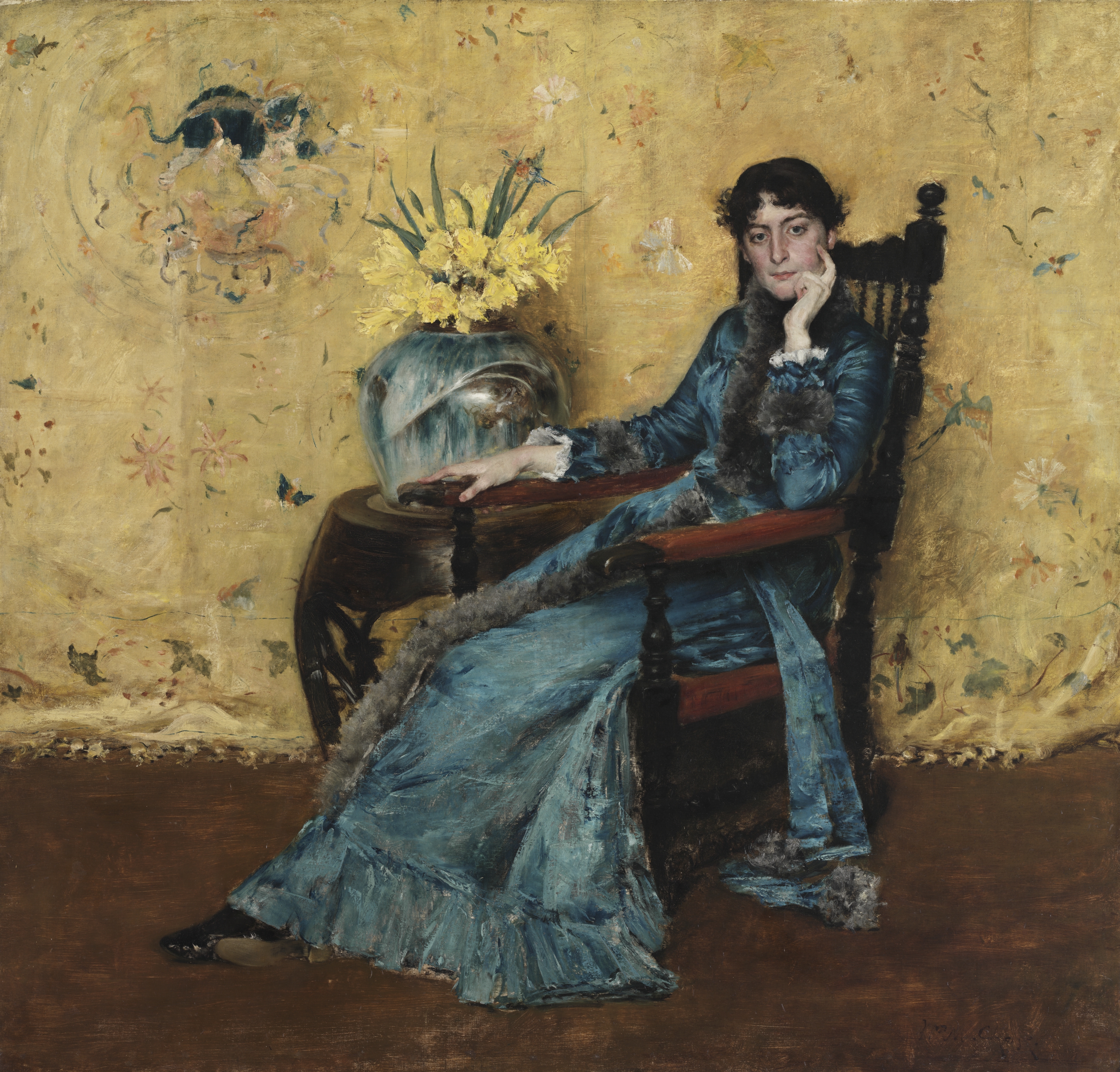
Deconstructing the Threads: A Fabric Analysis of *Portrait of Dora Wheeler* through the Avant-Garde Lens
At Zoey Fashion Lab, our mission is to unravel the fabric of history, not merely to observe it, but to extract the genetic code of design innovation. In this analysis, we turn our attention to a seminal work of American portraiture: Cecilia Beaux’s 1889 masterpiece, *Portrait of Dora Wheeler*. Painted in oil on canvas, this work is often celebrated for its technical brilliance and intimate portrayal of a young woman in her creative sanctuary. However, for the Chief Fabric Deconstructionist, the painting is not a static image but a dynamic New DNA Strand—a blueprint for an avant-garde fashion lineage. We will dissect the painting’s materiality, its spatial architecture, and its psychological fabric to reveal how it prefigures a radical, deconstructed aesthetic that resonates with contemporary fashion theory.
1. The Canvas as a Living Membrane: Materiality and Surface
The first thread we pull is the substrate itself: oil on canvas. In Beaux’s hands, the canvas is not a passive surface but a living membrane. The oil paint is applied with a palpable tension—thin, almost transparent washes in the background, juxtaposed with thick, impasto strokes on Dora’s dress. This duality of surface texture mirrors the avant-garde principle of “unfinish”, where the raw materiality of the fabric (or in this case, paint) is left exposed.
For Zoey Fashion Lab, this translates directly into fabric deconstruction. The background’s translucent washes evoke sheer organza or silk chiffon, where the warp and weft are visible, challenging the viewer to see the structure beneath the surface. The impasto on the dress, conversely, suggests heavy bouclé or hand-felted wool, where texture becomes a form of expression. We identify this as a proto-avant-garde technique: the artist refuses to smooth the surface, allowing the material’s inherent properties—its drag, its thickness, its response to light—to dictate the narrative. This is the first strand of our DNA: material honesty.
Furthermore, the canvas’s scale (approximately 84 x 50 inches) creates an immersive field. The fabric of the painting envelops the viewer, much like an architectural garment. We propose that Beaux’s canvas acts as a prototype for the deconstructed runway, where the “fourth wall” of fashion—the distance between garment and audience—is dissolved. The oil medium’s slow drying time allowed Beaux to rework and layer, a process we analogize to textile layering in avant-garde fashion: a lattice of tulle over a rigid corset, or a cascade of raw-edged silk over a structured wool base. The canvas is not a finished product; it is a process made visible.
2. The Dress as a Deconstructed Architecture: Form and Silhouette
Dora Wheeler’s garment is the epicenter of our analysis. It is not a simple dress but a deconstructed architecture. The painting captures a moment of transition: the dress appears to be in motion, its folds and creases suggesting both a natural drape and a deliberate, almost sculptural manipulation. The fabric—likely a heavy silk or velvet—is painted with a geometric precision that belies its organic flow. The sleeves are voluminous, the bodice cinched, yet the fabric seems to resist the body, creating negative space.
This tension between structure and fluidity is a hallmark of the avant-garde. We identify the dress as a precursor to Rei Kawakubo’s “lumps and bumps” or Martin Margiela’s deconstructed tailoring. The collar, for instance, is not a simple band but a complex, almost architectural collar that rises and falls like a fabric scaffold. The sleeves, with their deep pleats, evoke the kimono silhouette but are rendered in a Western context, creating a hybrid form. This is the second strand: hybridity and structural subversion.
Moreover, the dress’s color—a deep, almost black navy—absorbs light, creating a void against Dora’s pale skin and the vibrant background. In fashion terms, this is a chromatic deconstruction: the garment becomes a negative space, a silhouette that defines the body by its absence. We trace this to the avant-garde use of monochrome (e.g., Yohji Yamamoto’s black-on-black) to strip fashion of ornament and force focus on form. Beaux’s choice to render the dress in such a dark, nearly black hue is not merely realistic; it is a deliberate erasure of detail, pushing the viewer to engage with the garment’s architecture rather than its surface pattern.
3. The Sitter as a Living Mannequin: Identity and Performance
Dora Wheeler herself becomes a living mannequin for our deconstruction. She is not passive; her pose—seated, one hand resting on a table, the other holding a paintbrush—suggests agency. She is an artist, a creator, not just a subject. This performative identity is central to avant-garde fashion, where the wearer is co-creator of the garment’s meaning. Beaux captures Dora in a moment of creative pause, her gaze direct yet introspective. The dress, with its complex folds, becomes a second skin that both reveals and conceals her creative energy.
We deconstruct this as a narrative of autonomy. The avant-garde fashion movement, particularly in the 1990s and 2000s, often used models as “blank slates” (e.g., Alexander McQueen’s robotic mannequins or Margiela’s faceless figures). However, Beaux inverts this: Dora’s face is highly individualized, while her dress is abstracted. This creates a dialectic between the personal and the universal. For Zoey Fashion Lab, this suggests a new strand: identity as fabric. The garment is not just clothing; it is a narrative membrane that carries the sitter’s history, her labor, and her creative vision. The paintbrush in her hand is a fashion tool—a needle or a pair of scissors—that deconstructs the boundary between artist and subject, designer and wearer.
4. The Background as a Textile Landscape: Space and Movement
The background of *Portrait of Dora Wheeler* is not a neutral backdrop. It is a textile landscape of abstracted forms—a tapestry, a curtain, perhaps a painted screen. Beaux uses loose, almost calligraphic brushstrokes to depict these elements, creating a fabric-like texture that envelops the sitter. The colors—muted golds, greens, and blues—are woven together like a jacquard or brocade, but without the rigidity of pattern. Instead, they flow and shift, suggesting movement.
This is the fourth strand: spatial deconstruction. The background is not a static space but a dynamic field that interacts with the figure. We see this as a precursor to avant-garde fashion shows where the environment (e.g., the runway, the lighting, the set) is as integral as the garment. Beaux’s background is a fabric of time, a woven moment that captures the energy of Dora’s studio. For fashion, this translates to garments that are not confined to the body but extend into space—trains, capes, asymmetrical hems that create a textile architecture. The background’s abstraction also suggests a deconstruction of pattern: the painterly strokes mimic the chaotic beauty of raw-edge fabric or deconstructed knitwear, where the structure is visible yet fluid.
5. The New DNA Strand: Avant-Garde Implications for Zoey Fashion Lab
Synthesizing these strands, we arrive at a new genetic code for fashion design. *Portrait of Dora Wheeler* is not a historical artifact but a living blueprint for avant-garde practice. The painting’s material honesty (strand 1) demands that we use fabrics that reveal their construction—raw edges, exposed seams, transparent layers. Its structural subversion (strand 2) calls for architectural silhouettes that challenge the body’s natural form, using draping and pleating to create negative space. The performative identity (strand 3) insists that garments be co-authored with the wearer, allowing for movement, agency, and narrative. Finally, the spatial deconstruction (strand 4) pushes fashion beyond the body, into environmental textiles that blur the line between garment and space.
For Zoey Fashion Lab, this analysis informs a new collection: “The Wheeler Code.” We will translate Beaux’s impasto into hand-felted wool with visible stitching. The background’s abstracted tapestry will become a digital print on silk organza, with painterly strokes that mimic the brushwork. The dress’s deconstructed architecture will inspire a modular garment system—a jacket that can be reconfigured into a cape, a skirt that becomes a train. Most importantly, the sitter’s autonomy will be honored through interactive design elements: adjustable closures, removable panels, and pockets that invite the wearer to engage with the garment as a creative tool.
In conclusion, *Portrait of Dora Wheeler* is a fabric of radical potential. It is a New DNA Strand that connects the 19th-century avant-garde to the 21st-century fashion laboratory. By deconstructing its threads, we not only honor Beaux’s genius but also weave a new future for fashion—one that is honest, subversive, performative, and spatial. At Zoey Fashion Lab, we do not merely analyze the past; we re-thread it into the fabric of tomorrow.