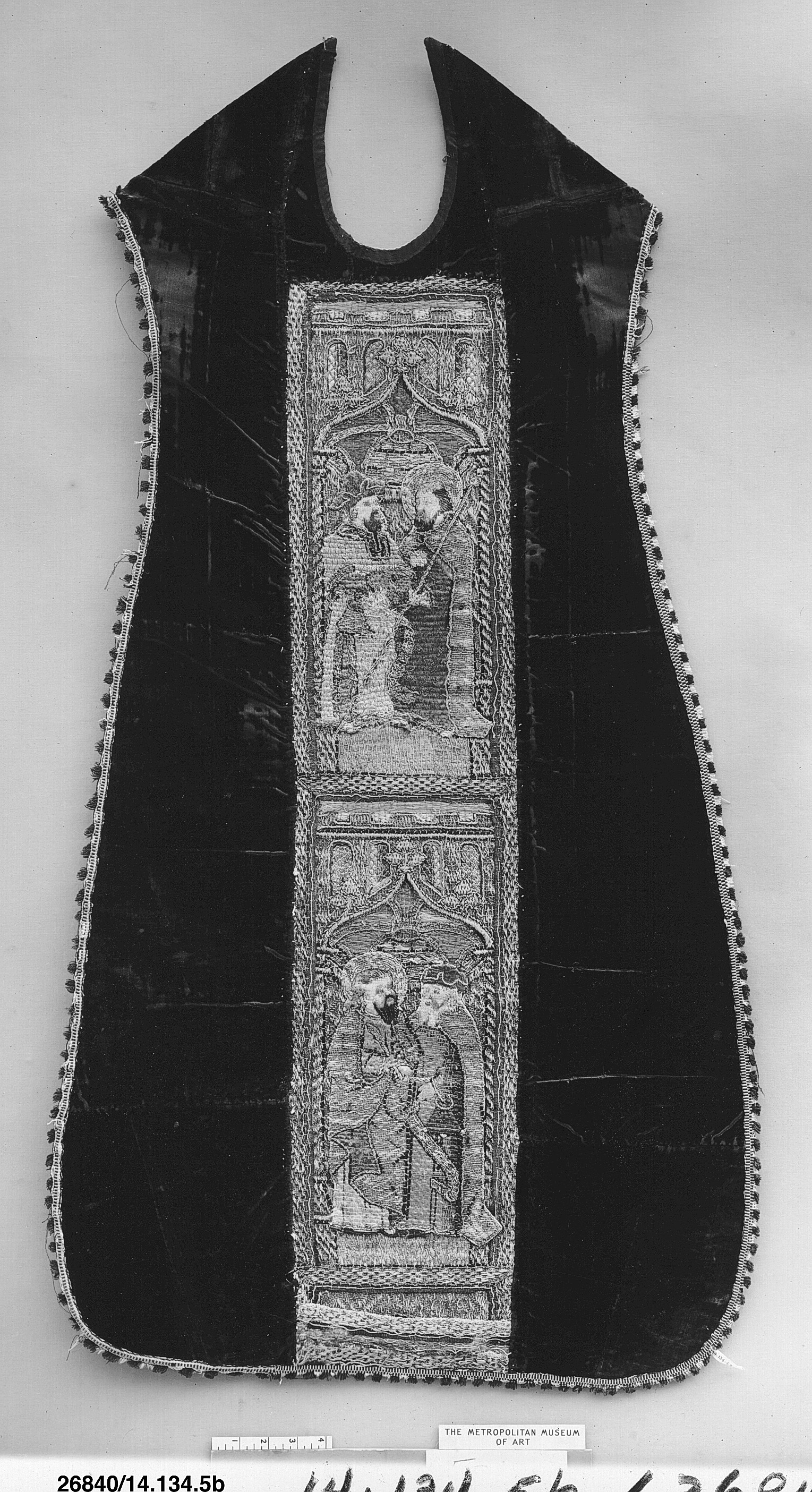
Deconstructing the Sacred: The Chasuble as a Blueprint for SS26 Structural Innovation
The ecclesiastical garment, historically a vessel for liturgical narrative and spiritual transcendence, offers an unexpected yet fertile ground for avant-garde couture. At Zoey Fashion Laboratory, we do not view historical artifacts as static relics; we perceive them as a lexicon of structural possibilities, waiting to be deconstructed and re-encoded for a future-oriented aesthetic. The subject of this definitive analysis—a French chasuble from the late medieval or early Renaissance period, executed in sumptuous velvet, silk, and gold thread, and bearing the iconography of the Virgin and Child, Apostles, and Prophets—presents a radical proposition for Spring/Summer 2026 (SS26). This garment is not merely a cloak of faith but a complex architectural system of volume, drape, and symbolic layering. By stripping away its religious context and focusing on its futuristic silhouettes and structural innovation, we unlock a new language of garment architecture that challenges the very boundaries of the human form.
I. The Velvet as a Membrane: Materiality and Thermodynamics
The chasuble’s primary material—velvet, woven with silk and gold thread—demands a re-evaluation of texture as a structural element. In the context of SS26, this is not a fabric of opulence but a thermodynamic membrane. The velvet’s pile creates micro-pockets of air, offering a volumetric, almost pneumatic quality. The gold thread, traditionally used to signify divine light, becomes a conductive filament, suggesting a garment that can interact with its environment—perhaps through light refraction or heat retention. For the avant-garde studio, we propose a re-engineering: the velvet is laser-cut into a lattice, its pile direction manipulated to create directional flow. The silk base becomes a secondary skin, while the gold thread is woven into a circuit-like pattern. This transforms the chasuble from a flat, draped object into a three-dimensional, responsive surface. The weight of the velvet is not a burden but a gravity-anchoring system, allowing for dramatic, gravity-defying cantilevers when paired with a lightweight, carbon-fiber or bio-resin substructure.
II. Deconstructing the Silhouette: From Liturgical Apex to Futuristic Armor
The traditional chasuble silhouette—a poncho-like form with a central opening—is inherently a negative-space garment. It creates a void around the body, a cave of fabric. For SS26, we invert this concept. The garment’s iconic shape is reimagined as a modular exoskeleton. The front panel, once a flat surface for the Virgin and Child, is now a kinetic shield. Using pattern-cutting techniques derived from origami and parametric design, the velvet is pleated into a honeycomb structure that can expand and contract. The Apostles and Prophets, rendered in gold thread, become structural seams—their halos and staffs are reinterpreted as tensile cables that pull the fabric into a series of sharp, angular peaks. This creates a silhouette that is both protective and aggressive, reminiscent of futuristic armor yet soft to the touch. The back panel, traditionally the most voluminous part, is sliced open and re-layered, forming a train of cascading, asymmetrical folds. This is not a train of ceremony but a study in controlled chaos—a dynamic counterbalance to the rigid front. The overall effect is a silhouette that oscillates between architectural monument and second skin, a continuous dialogue between the sacred and the cybernetic.
III. The Iconography as Structural Code: Virgin, Child, Apostles, Prophets
The figurative imagery is the most potent tool for innovation. In the original chasuble, these figures are narrative anchors. In our avant-garde interpretation, they become load-bearing elements. The Virgin and Child, traditionally positioned at the center front, are reimagined as a central keystone. The child’s form is abstracted into a geometric sphere, suspended within a web of gold thread, acting as a pivot point for the garment’s drape. The Apostles, arranged around the hem, are translated into peripheral stabilizers—their elongated figures become vertical darts and gussets that control the fabric’s fall. The Prophets, often depicted on the shoulders, are redesigned as cantilevered shoulder pads, their scrolls unfurling into structural wings. This is not mere decoration; it is a functional iconography where every figure dictates a line of tension or a point of release. The gold thread, previously outlining halos, is now a tensile web that connects these points, creating a garment that is self-supporting, almost like a suspension bridge. The narrative is no longer biblical but biomechanical—a story of how form follows function within a sacred geometry.
IV. Structural Innovation for SS26: The Chasuble as a Wearable Habitat
The ultimate innovation lies in the garment’s potential for transformative volume. The chasuble’s traditional ample cut, designed to cover the entire body, is perfect for exploring expandable architecture. For SS26, we propose a pneumatic system integrated into the velvet’s lining. Micro-inflatable chambers, powered by a discreet, flexible battery, can be activated to alter the silhouette in real-time. The Virgin and Child’s protective embrace becomes a collapsible dome that inflates around the wearer’s torso, creating a personal space bubble. The Apostles’ figures become articulated joints that allow the garment to morph from a sleek, body-conscious sheath to a voluminous, habitable structure. This is not a costume; it is a wearable habitat—a response to the future’s demands for fluidity, protection, and adaptability. The gold thread, now embedded with fiber-optic filaments, can illuminate the iconography, turning the garment into a light-emitting sculpture that communicates its structural state. The chasuble thus transcends its liturgical origins to become a cybernetic organism, a living system that breathes, expands, and contracts with the wearer’s movement and environment.
V. Conclusion: The Sacred as a Blueprint for the Future
In this analysis, the French chasuble is not a relic but a provocation. Its velvet, silk, and gold thread are not materials of the past but prototypes for the future. By deconstructing its iconography into structural code and reimagining its silhouette as a kinetic, responsive system, we have created a blueprint for SS26 that is both deeply historical and radically futuristic. The garment is transformed from a symbol of divine hierarchy into a manifesto of human potential—a wearable architecture that celebrates the body’s ability to inhabit and transform space. At Zoey Fashion Laboratory, we do not copy the past; we reprogram it. This chasuble is our starting point for a collection that explores how sacred geometry, material science, and structural innovation can converge to define the next frontier of avant-garde couture. The Virgin and Child, Apostles, and Prophets are no longer figures of faith; they are the architects of a new silhouette, one that is as timeless as it is tomorrow.