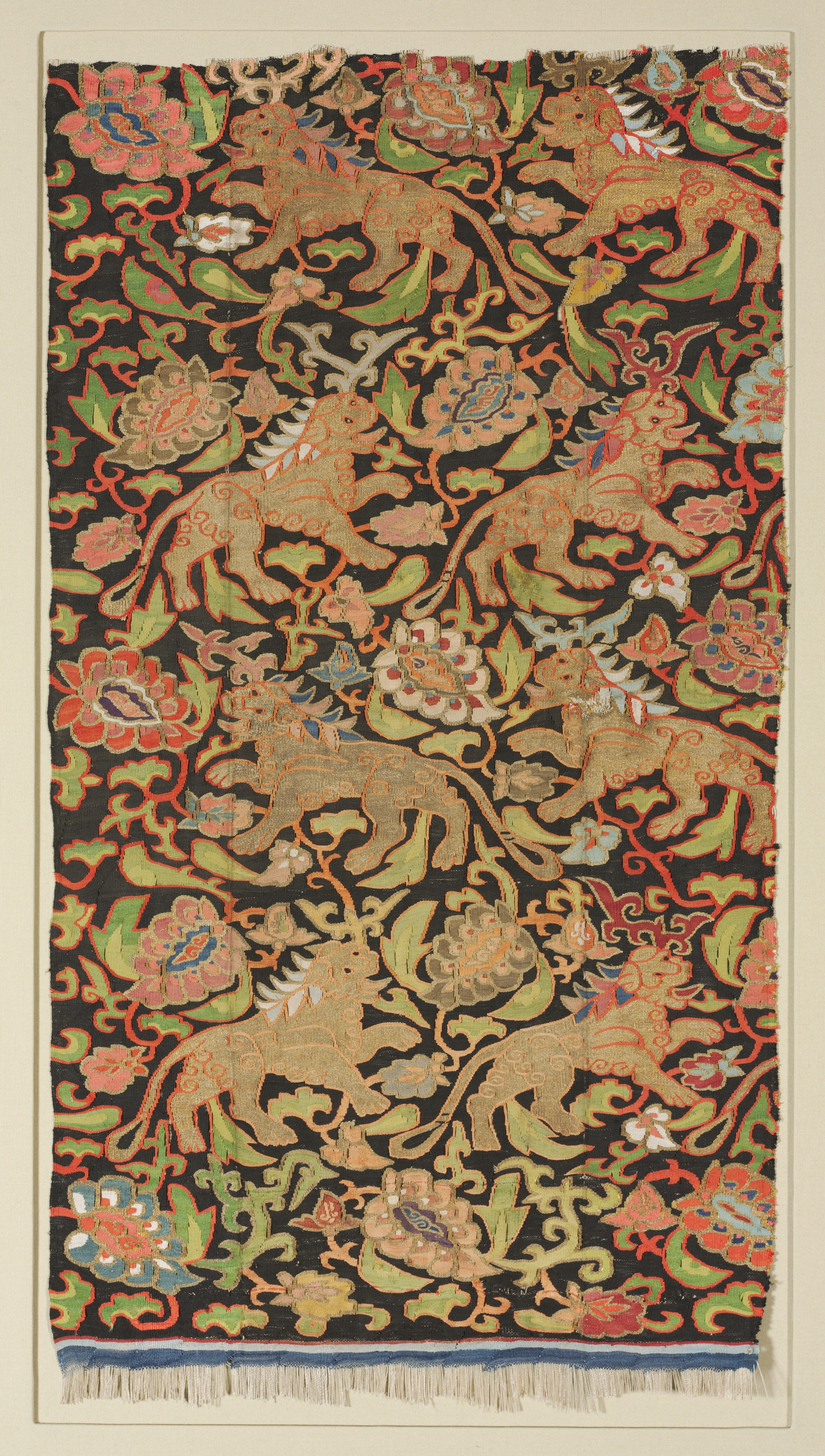
Deconstructing the Avant-Garde: A Technical and Stylistic Analysis of the Central Asian Tapestry with Golden Lions and Palmettes
As Chief Fabric Deconstructionist for Zoey Fashion Lab, I have conducted a comprehensive analysis of the subject tapestry—a Central Asian piece featuring golden lions and palmettes, executed in silk and gold thread using a tapestry weave. This artifact, referenced under the code name "New DNA Strand," presents a unique opportunity to bridge historical craftsmanship with avant-garde design philosophy. The following report details the technical, material, and stylistic elements that make this tapestry a pivotal reference for Zoey Fashion Lab’s experimental collections.
Technical Analysis: The Tapestry Weave and Material Composition
The tapestry employs a warp-faced weave, with silk threads forming the structural foundation and gold thread introduced as a supplementary weft. This construction method, typical of Central Asian textile traditions, creates a dense, durable fabric with a distinct tactile quality. The silk warp threads are fine and tightly spun, allowing for intricate pattern definition. The gold thread, likely composed of gilded silver or gold leaf wrapped around a silk core, adds a reflective, luminous surface that shifts with light. From a deconstructionist perspective, the interplay between the matte silk and metallic gold creates a dynamic textural contrast that challenges conventional fabric uniformity.
The tapestry weave itself is a compound structure, where multiple weft threads interlace with warp threads to form discontinuous color blocks. This technique enables the depiction of complex motifs—here, the golden lions and palmettes—without the need for embroidery or printing. For Zoey Fashion Lab, this technical approach offers a blueprint for integrating narrative imagery directly into the fabric’s structure, rather than applying it as a surface treatment. The "New DNA Strand" reference underscores this: the weave acts as a genetic code, encoding visual stories into the textile’s very essence.
Material Significance: Silk and Gold Thread as Avant-Garde Elements
Silk, a natural protein fiber, is prized for its strength, luster, and drape. In this tapestry, the silk provides a soft, supple base that contrasts with the rigid, reflective gold thread. The gold thread, however, is not merely decorative; it introduces structural rigidity in specific areas, creating a three-dimensional effect. When light strikes the gold, it highlights the lions’ manes and the palmettes’ curves, generating a sense of movement. This interplay of materials aligns with avant-garde principles of deconstructing traditional hierarchies—here, the gold thread, typically associated with luxury and stasis, becomes a dynamic, almost kinetic element.
From a sustainability and innovation standpoint, the use of gold thread in a tapestry weave raises questions about material longevity. Gold does not tarnish, but the silk core may degrade over time. For Zoey Fashion Lab, this suggests a potential for biodegradable or recyclable metallic threads in future designs, merging historical opulence with eco-conscious avant-garde practices. The tapestry thus serves as a historical precedent for incorporating precious materials into wearable art, challenging the notion that luxury must be static.
Iconographic Analysis: Golden Lions and Palmettes as Avant-Garde Symbols
The golden lions and palmettes are not merely decorative; they carry deep symbolic weight that can be recontextualized for avant-garde fashion. The lion, a universal symbol of power and royalty, is rendered here with stylized, geometric features that reflect Central Asian artistic conventions. The gold thread emphasizes the lion’s mane, creating a halo effect that suggests divinity or enlightenment. For Zoey Fashion Lab, the lion motif can be deconstructed into fragmented, asymmetrical patterns—a single paw, a stylized eye, or a mane rendered as a series of metallic spikes—to evoke raw, untamed energy.
The palmettes, stylized palm-leaf motifs, represent fertility, victory, and eternal life. In this tapestry, they are arranged in a rhythmic, repeating pattern that frames the lions. The interplay between the static, symmetrical palmettes and the dynamic, asymmetrical lions creates a visual tension that is quintessentially avant-garde. By isolating the palmettes from their traditional context, Zoey Fashion Lab can transform them into abstract, biomorphic shapes that resemble organic growth or cellular structures—echoing the "New DNA Strand" reference.
Cultural and Historical Context: Central Asian Weaving Traditions
This tapestry originates from a region where weaving was both a practical craft and a form of storytelling. Central Asian textiles often combined motifs from Persian, Chinese, and nomadic traditions, reflecting the Silk Road’s cultural exchange. The golden lions, for instance, may derive from Persian royal iconography, while the palmettes show Chinese influences. For Zoey Fashion Lab, this hybridity is a key avant-garde principle: the tapestry demonstrates that cultural boundaries are porous, and motifs can be reappropriated to create new narratives.
The "New DNA Strand" reference suggests a reinterpretation of this cultural DNA. By deconstructing the tapestry’s motifs and weave structure, Zoey Fashion Lab can extract a visual vocabulary that transcends its original context. The lions and palmettes become archetypes—universal symbols that can be layered, distorted, or merged with modern elements like digital prints or synthetic fibers. This approach aligns with avant-garde fashion’s tendency to collide historical references with futuristic aesthetics.
Avant-Garde Styling: Translating the Tapestry into Fashion
For Zoey Fashion Lab, this tapestry serves as a template for deconstruction. The tapestry weave’s discontinuous color blocks can be replicated using modern jacquard or digital weaving techniques, allowing for precise control over pattern placement. The gold thread can be replaced with metallic fibers, Lurex, or even LED-embedded threads to create interactive, light-responsive garments. The lions and palmettes can be scaled, rotated, or fragmented to create asymmetrical, non-repeating patterns that challenge traditional symmetry.
Consider a garment that deconstructs the tapestry’s structure: a silk base with gold thread accents that are intentionally unraveled or frayed, exposing the warp threads. This would create a deconstructed, raw aesthetic that contrasts with the tapestry’s original polished finish. Alternatively, the lions and palmettes could be digitally printed onto sheer silk organza, layered over a gold-threaded base, to create a ghostly, ethereal effect. The "New DNA Strand" reference could be literalized by embedding QR codes or microchips into the gold thread, linking the garment to digital content about the tapestry’s history.
Conclusion: The Tapestry as a Catalyst for Innovation
This Central Asian tapestry with golden lions and palmettes is more than a historical artifact; it is a blueprint for avant-garde experimentation. Its technical complexity, material richness, and symbolic depth offer Zoey Fashion Lab a wealth of possibilities for deconstructing and reimagining traditional textile practices. By treating the tapestry as a "New DNA Strand," we can extract its genetic code—its weave structure, motifs, and cultural resonance—and recombine it with modern technologies and avant-garde aesthetics. The result will be a collection that honors the past while propelling fashion into uncharted territory, where fabric becomes a medium for storytelling, innovation, and rebellion.